Pages

Showing posts with label patents. Show all posts

Wednesday, April 20, 2011

Paul Revere art deco patented wood brass hemisphere book end

This neat book end says “Revere, Rome, NY, Patent applied for”.  As it turns out, the patent was issued January11, 1935.  See the patent here. The fellow that invented it was employed by Revere Copper and Brass incorporated. 

The company is still going strong, known today as Revere Copper Products incorporated and is one of the oldest manufacturing companies in the United States.  The company was founded in 1801 by Paul Revere, the very same fellow we all read about whom on April 18th, 1775 made his famous ride from Boston to Concord warning the colonists that the British were coming.   Turns out he wasn’t just good at riding horses and shouting warnings, he was also a great artisan / craftsmen, who later turned into an equally fantastic industrialist / manufacturer. 
 
Early on he was a prominent silversmith making utensils, bronze bells, and other such things.  By 1800 he had figured out how to roll copper into sheets, freeing the fledgling country from it’s necessity to import copper sheets from England to strengthen the hulls of their warships.  In 1801 he rolled the first copper sheets in America, refining up to 1800 pounds of copper at a time using only wood for fuel, and supplying the navy with copper sheets without the need to import any. In addition to rolling copper sheathing for ships, Paul Revere made sheathing for the State House in Boston, which required 7,675 lbs. of copper sheathing and 789 lbs. of copper nails, at a cost of $4,232. The roof of the State House in Boston lasted 100 years.

So as it turns out, what appears to be a brass sheathing coil attached to a hemisphere shaped piece of wood, made at some point prior to 1935, is in fact  a piece of American history. 

Here are a few great resources:


The vintage Revere bookend pictured here has been sold.

More?

Monday, April 18, 2011

Tap-Icer vintage patent bar ware item

So I stumbled across this little gem called the Tap-Icer, "Cracks Ice in a Jiffy".  It has a patent that you can see here from 1962, which is a improvement over a similar invention from the 1940's.

According to the instructions you "Place an ice cube in your hand.  With the other hand vibrate the Tap-Icer with wrist action.  After a few light taps the ice cracks into many pieces.  The special spring action does the trick.  Vibrate about two to three inches above the flat surface of the ice... don't pound."
 
After trying it out, I understand somewhat why this item isn't in every household in America, because most Americans simply put ice cubes in a zip lock bag and hit them with hammers!

The vintage tap icer barware ice crushing tool pictured here has been sold.


More?
Vibratory action

Friday, April 8, 2011

S.S.S. patented metal doo-hickey mystery


Measuring about 3 inches x 3 inches this little doo-hickey has "S.S.S." stamped on it along with indications it has patents from July 1, 84, & May 12, 85.  My initial patent search turned up nothing, nor did any of my other searches for that matter!

By squeezing the wire pins that hold the arm in place, one can move the arm up and down a little bit, releasing the pins will hold it in that place.  There is an oval shaped ring on the pin side.

A confounding little piece!  Anyone leading me to the answers here might just find a little surprise package in their mailbox!

Update
Thanks to my uncle Bobby who lead us in the right direction, and thanks to the folks at Patent Place USA for knowing how to look for this and actually finding it!

It is a "Scarf Shield" from the late 1800's, designed to hold neck-ware in place.  My You Tube Video explains it in detail.

Here is the first patent, regarding the mechanism that is made to hang on buttons.
Here is the second patent, that is actually of this piece.


More?
doo-hickey
metal
Patent art  
Inventions
Scarves

Wednesday, February 16, 2011

1960s Anholt Ashtray, lessons in American History


The Item
It’s like I was back in the bowling alleys with my folks on league night as a little kid! 

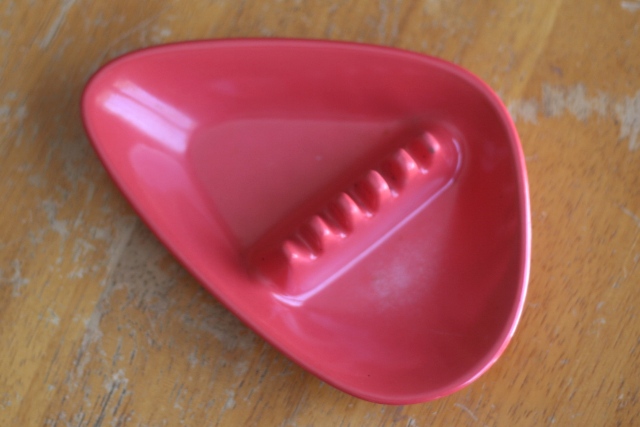
This 1960s plastic ashtray is made by the Asholt-Ashtray company, and is a patented piece:  US PAT. #2352756 DES. 196351. 


This pieces measures at it’s longest point (over the holders), 6.5 inches.  I would say it is more of a “Salmon” color then the pictures present.  The bottom is clearly imprinted with company name and the patent numbers.

The Patent date
The patent was issued on September 17, 1963, a seemingly innocuous day in American History.

Until you consider that on September 17, in the year:

1630 The city of Boston was founded, eventually to become a bastion of American revolutionaries and become a foundation place in American history.

1814 Amateur poet, Francis Scott Key put the finishing touches on his poem, “Defence of Fort McHenry”, eventually becoming the lyrics of “The Star Spangled Banner”, which officially became the national anthem of The U.S.A. in 1931.

1862 Beginning of the civil war, more specifically the one day battle of Sharpsburg, AKA Antietam, bloodiest day in American history with over 23,000 casualties.

1920 The NFL is organized, home of the De Facto American holiday, Super Bowl Sunday.

2001 The New York Stock Exchange opens for the first time since 9-11

2010 After a 54 year run, the soap opera, “As the World Turns”, broadcasts it’s final episode.

Perhaps this piece of Americana knows much more than we think!

This item has been sold.


Spark an interest?

Wednesday, February 9, 2011

Coleman Lantern model 242C made in 1945


The model 242C single mantle Coleman lantern was manufactured in November of 1945.  The bottom of this one is stamped with a 5 and an 11.  Prior to 1947 the left number represents the final digit of the year, and the right hand number representing the month.  The 242C was manufactures from 1942 until 1950, so we know this lantern was made in 1945, the 11th month. 

W.C. Coleman had poor eyesight and was attracted to the steady white light of the “new” gasoline powered lanterns of the time.  As the story goes, the young salesman was taking a stroll after a hard day’s work selling typewriters, and spotted a new type of lamplight in a drugstore window in Brockton, Alabama. This new light burned with a strong, steady white flame and was fueled by gasoline. The standard lamp of the era burned kerosene and produced a smoky, flickering, yellowish light.  This new, steady white light enabled him to read even the smallest print in books and on medicine bottles, and he saw great potential in this new technology and founded a company that would eventually make his name a household word to any American family who spent time outdoors.
 
Some of the model 242C’s were finished in nickel plated metal rather than the green paint on this one.  I don’t know how many of each were produced, but it would be interesting to find out.  There are two patents listed on the lantern; 1973184 & 2008882.  Both by Boyd W. Tullis in the mid 1930’s, one for the  "Removable Tip Cleaning Needle and Generator" on this piece and one for the "Lamp" of the model 242’s.

This item has been sold

Coleman Collector resources

 Want more?