Pages

Showing posts with label marks. Show all posts

Monday, March 4, 2013

Bayreuth Made In Germany Frankurt Main eagle bone china porcelain tea cup


This sweet little tea cup is an intriguing piece.  For starters, it’s quite diminutive, measuring only 3 inches across and an inch and a half tall.  The inside has this wonderful hand painted red, black & gold motif featuring an interesting eagle wearing a crown.  
 
Below is the words “Frankurt e. Main", though the middle initial (?) is hard to make out.  At first glance, and second for that matter, I read Frankfurt. Oddly a search with the term"Frankfurt" turned up a similar eagle being used on products on Zazzle touting the city.   (product image of something from Frankfurt). Though the eagle motif is common German insignia.  Any searches with Frankurt in the string turns up pretty much nothing. It seems like it must be a name, but beyond that it is a mystery to me.

 The gilding on the rim, handle, and base all seem intact and in good shape.  It weights 1.2 ounces.  On the bottom it says it is “handpainted” and "Made in Germany".  It also has what appears to be an “S” above “Bayreuth”.  The eagle on the front is certainly reminiscent of Royal Bayreuth lions (http://www.porcelainmarksandmore.com/bavaria/tettau_1/00.php).  However the mark on the bottom does not seem to be a Royal Bayreuth, and in fact I can't find anything similar.  
 
So I present a bit of a mystery for those china mark buffs out there- enjoy!

This item available here: https://www.etsy.com/listing/125449835/bayreuth-german-frankurt-main-eagle-bone

Thursday, April 14, 2011

Vintage hand painted Ransburg Red Aster stoneware set ca. 1930 - 1960

This set is from the Ransburg Company’s “Red Aster” pattern, used on their popular stoneware from 1930 – 1960. Each piece was hand painted by a well trained decorator, at a time when most companies were exploring cutting quality for cost, Harper Ransburg invested time and money into training professionals that makes Ransburg quality unmatched with any of it’s contemporaries.

Harper J. Ransburg’s story is a testament to the American entrepreneurial system. He was born in Indiana in 1886, the son of German Quaker farmers. He dropped out of school in the eighth grade to help support his family. It seems he could have gone on to be a Professor in marketing at an Ivy-League school. He was one of the first to market items as "sets" rather than individual pieces, so in a way he is to thank for your cell phone “bundling” package! He also threw in free stuff such as selling cookie jars full of cookies. Ransburg figured out the importance of "cross-selling," and put it to good use. Ransburg developed a highly successful business with a range of product lines.

Instead of the college route, he founded a glass cutting business in Toledo, OH, and with a gamble on a loan, he moved operations to Indianapolis, Indiana in 1912. There, in short order he launched a multi-million dollar household products company, that at it’s peak was selling 250,000 hand painted cookie jars per year.

Ransburg products reflect pride and craftsmanship. The company had a large range of products made from all sorts of material, glass to metal, plastic to pottery, each one now drawing in collectors.  There are some great books on this company, check the Amazon links below.


What about this stuff on Amazon?
Salt & Pepper shakers

Thursday, March 31, 2011

vintage 1968 plaid fold away basket company highlander model Highlights for Children

This piece is not a complete mystery… in fact it isn’t much of a mystery at all.  At least on the surface.

Lets start with the box... which tells us this is the all purpose folding basket called "Fold-Away", a registered trademark.  I can’t find who had it registered.   It was mailed to an address in Massachusetts during the summer of 1968, according to the postage. The label tells us it was sent from the still operational magazine, Highlights for Children, out of Columbus, Ohio.

Which makes me wonder if this was a “reward” of some sort from the magazine? 

The wood handled basket lays flat in the closed position, measuring about 11 x 14 inches. Opened up the basket is about 10 x 14 and about 7 inches deep. Unfinished metal supports that simply push in place, give the basket it's structural integrity while open.

According to the metal post bracket on the inside of this basket, it was made by the Fold-Away Basket Company out of Madison, Indiana, and lists two patents: 2.042.977 & 2.228.248.
 
A very utilitarian piece with some interesting and mysterious history, perhaps someone out there can tell us more?

This item has been sold

Interested in...

Wednesday, February 16, 2011

1960s Anholt Ashtray, lessons in American History


The Item
It’s like I was back in the bowling alleys with my folks on league night as a little kid! 

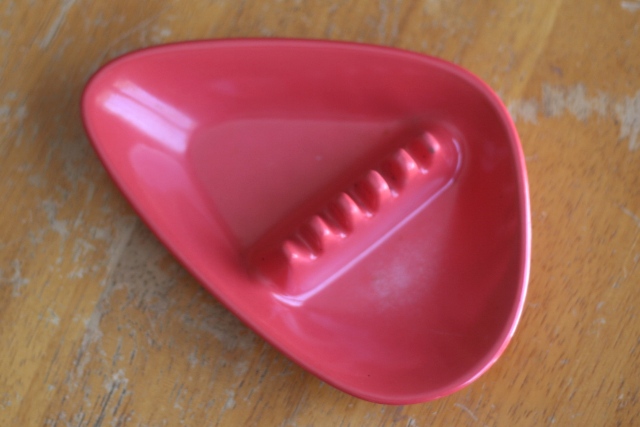
This 1960s plastic ashtray is made by the Asholt-Ashtray company, and is a patented piece:  US PAT. #2352756 DES. 196351. 


This pieces measures at it’s longest point (over the holders), 6.5 inches.  I would say it is more of a “Salmon” color then the pictures present.  The bottom is clearly imprinted with company name and the patent numbers.

The Patent date
The patent was issued on September 17, 1963, a seemingly innocuous day in American History.

Until you consider that on September 17, in the year:

1630 The city of Boston was founded, eventually to become a bastion of American revolutionaries and become a foundation place in American history.

1814 Amateur poet, Francis Scott Key put the finishing touches on his poem, “Defence of Fort McHenry”, eventually becoming the lyrics of “The Star Spangled Banner”, which officially became the national anthem of The U.S.A. in 1931.

1862 Beginning of the civil war, more specifically the one day battle of Sharpsburg, AKA Antietam, bloodiest day in American history with over 23,000 casualties.

1920 The NFL is organized, home of the De Facto American holiday, Super Bowl Sunday.

2001 The New York Stock Exchange opens for the first time since 9-11

2010 After a 54 year run, the soap opera, “As the World Turns”, broadcasts it’s final episode.

Perhaps this piece of Americana knows much more than we think!

This item has been sold.


Spark an interest?

Sunday, February 13, 2011

Cool Qianlong Chinese ceramic plate and George Washington


Chinese ceramic mark philosophy
Chinese artists hold a different philosophy than most of their contemporaries world wide.  In Europe and America for instance a potter will put their own company or individual mark on the piece if they made it, even if it follows a style of an earlier artist.  A piece is considered an individual item set aside on it’s own merit.  These artists’ would frown upon using the mark of the earlier artist they are emulating, unless there is some intent to deceive.

In china however artists pay homage to the creators of the design or form.  It is thought honorable to use the mark of the earlier artist who’s style is being copied or emulated.  As a fictional example, if Americans followed the same philosophy and Benjamin Franklin had made a line of ceramic wares that depicted a design of kites and lighting, and in 1950 John Smith made a similar line, he would honor the original artist and use the same mark that Ben used even though his wares were much newer and not even made during the same time as Ben Franklin. 

Sometimes Chinese artists might make a minor alteration to the mark to stamp it as his work, but to the casual observer the alteration would be very hard to spot. To the western mind this practice might seem unfair and slightly deceitful.  To the Chinese this was considered an honorable practice and a sign of respect. 
 
This practice makes dating Chinese wares extremely difficult.  Perhaps if I could read Chinese it would be easier!  

This plate
After pouring through thousands of known Chinese marks, and scrutinizing the lines, I managed to find an exact match of this Qianlong 6 character double frame.  Qianlong was a Chinese emperor who ruled China during the late 18th century.  (We’ll learn more about him shortly.)  This mark is connected to this period, but not made during that period.  The box has two lines, making it a “double frame”, and there are six characters written within the box.  This mark is known specifically as a  Da Qing Qianlong Nian Zhi mark, used between 1949 and 1966.   

I doubt this is a reproduction, a copy of a particular piece from an earlier period, as I have not found reference to the paisley design being used earlier.  I am guessing (and it is a guess) that the layering style and build up of the design was developed during the Qianlong period, and hence honored in this mark.  The layers and depth in this paisley design are just incredible.  There is a texture and a beauty to this piece that I found simply stunning.  This wonderful piece of art has found a home in Washington D.C.

The Qianlong Emperor
There is a connection between Washington and this plate.  The Qianlong Emperor ruled from 1736 to 1796, a contemporary of George Washington who was president of the United States from 1789-97. The Qianlong Emperor and Washington both died in 1799, at ages 88 and 67, respectively. 

This emperor was a passionate art collector and writer.  During his 60 year reign, China expanded to an unprecedented size, encompassing Tibet, parts of Russia and the Koreas.  His grandfather, the  Kangxi Emperor, set a new precedent by touring the entire empire on several occasions.  The Qianlong Emperor followed in these footsteps, and completed 6 full southern inspection tours during his reign, unprecedented in Chinese history prior to Kangxi.  It is only under the reign of the Qianlong Emperor that the image of a multiethnic Chinese empire began to emerge, embracing Han, Mongol, Tibetan, Manchu, and other indigenous traditions.   

Not only did he encompass many religions, he patronized the arts, and the number of ancient Chinese paintings, literary works,  sculptures, and artifacts collected during the Qianlong Emperor's reign was also unprecedented. The collections of the national palace museums in both Beijing and Taipei were largely formed under the Qianlong Emperor and are the largest repositories of important Chinese artifacts that remain today.

THIS ITEM HAS BEEN SOLD
Million dollar art?

To answer "yes" would be a major understatement.  In November of 2010 A Qianlong period (c.1740) Imperial vase with six-character reign mark became the most expensive Chinese work of art ever to sell at auction anywhere in the world. It sold for $83 million. 

Wednesday, February 9, 2011

Coleman Lantern model 242C made in 1945


The model 242C single mantle Coleman lantern was manufactured in November of 1945.  The bottom of this one is stamped with a 5 and an 11.  Prior to 1947 the left number represents the final digit of the year, and the right hand number representing the month.  The 242C was manufactures from 1942 until 1950, so we know this lantern was made in 1945, the 11th month. 

W.C. Coleman had poor eyesight and was attracted to the steady white light of the “new” gasoline powered lanterns of the time.  As the story goes, the young salesman was taking a stroll after a hard day’s work selling typewriters, and spotted a new type of lamplight in a drugstore window in Brockton, Alabama. This new light burned with a strong, steady white flame and was fueled by gasoline. The standard lamp of the era burned kerosene and produced a smoky, flickering, yellowish light.  This new, steady white light enabled him to read even the smallest print in books and on medicine bottles, and he saw great potential in this new technology and founded a company that would eventually make his name a household word to any American family who spent time outdoors.
 
Some of the model 242C’s were finished in nickel plated metal rather than the green paint on this one.  I don’t know how many of each were produced, but it would be interesting to find out.  There are two patents listed on the lantern; 1973184 & 2008882.  Both by Boyd W. Tullis in the mid 1930’s, one for the  "Removable Tip Cleaning Needle and Generator" on this piece and one for the "Lamp" of the model 242’s.

This item has been sold

Coleman Collector resources

 Want more?

Thursday, February 3, 2011

Antique Grand Hotel Plate


There is a fascination to hold a true antique, a vintage piece of history over 100 years old.  This Mackinac Island Grand Hotel plate is the first true antique we’ve sold.  It is a ceramic decorative plate about 7 inches in diameter, sold to a great home in Chicago.


The Piece
The front of this piece is a ornate scene showing the front of the Grand Hotel on Mackinac Island Michigan.  The back has several marks. The Adams and the Jonroth marks are of particular interest and tell us a considerable amount about this piece.

Makers William Adam and Sons are potters out of Staffordshire UK, making wears since 1769, and what I can tell are still in operation.  They have used many different marks on their pieces over the years and during the turn of the century there were at least 10 different marks being used by the company during that time.  I managed to locate a very similar mark used by the company during the 1910s, 20s, and 30s.  However a distinct difference is that the “Adams” is above the crown, whereas on this plate is it below the crown.  So it seems likely the mark on this piece is perhaps an earlier version being used a bit earlier.  Particularly when tied to the associated Jonroth mark.

The Jonroth company, out of South Bend, Indiana, were importers of historical or souvenir designs pottery into the USA from 1890- 1909.  In 1909 they sold their business to the Wheelock Company also in Indiana.  They used the trade name: "Old English Staffordshire Ware" and were known to partner with the Adams factory in Staffordshire.  There is a clear provenance that this mark was used by the Jonroth Company between 1890 and 1909, which dates this piece over 100 years old.

The Grand Hotel
The Grand Hotel opened on Mackinac Island, Michigan, in 1887, with room rates of $3 - $5 per night and is still in operation.  It boasted the longest porch in the world, with no two guest rooms being exactly alike, and quickly become a destination for the famous and not so famous, from around the world. This National Historic Landmark  has hosting a Mark Twain lecture and two Hollywood films, just to give you a sense of the place. 

One of the most fascinating aspect of this place is that Mackinac Island where the Grand Hotel sits,  is an island without automobiles.  Flagging down a horse and carriage or hopping on a bicycle are the favored methods to get around.  The island sits out in Lake Huron, right off the tip of the fingers of the mitten that is, Michigan.

This item has been SOLD.  

Want more?