Pages

Showing posts with label ceramics. Show all posts

Monday, March 4, 2013

Bayreuth Made In Germany Frankurt Main eagle bone china porcelain tea cup


This sweet little tea cup is an intriguing piece.  For starters, it’s quite diminutive, measuring only 3 inches across and an inch and a half tall.  The inside has this wonderful hand painted red, black & gold motif featuring an interesting eagle wearing a crown.  
 
Below is the words “Frankurt e. Main", though the middle initial (?) is hard to make out.  At first glance, and second for that matter, I read Frankfurt. Oddly a search with the term"Frankfurt" turned up a similar eagle being used on products on Zazzle touting the city.   (product image of something from Frankfurt). Though the eagle motif is common German insignia.  Any searches with Frankurt in the string turns up pretty much nothing. It seems like it must be a name, but beyond that it is a mystery to me.

 The gilding on the rim, handle, and base all seem intact and in good shape.  It weights 1.2 ounces.  On the bottom it says it is “handpainted” and "Made in Germany".  It also has what appears to be an “S” above “Bayreuth”.  The eagle on the front is certainly reminiscent of Royal Bayreuth lions (http://www.porcelainmarksandmore.com/bavaria/tettau_1/00.php).  However the mark on the bottom does not seem to be a Royal Bayreuth, and in fact I can't find anything similar.  
 
So I present a bit of a mystery for those china mark buffs out there- enjoy!

This item available here: https://www.etsy.com/listing/125449835/bayreuth-german-frankurt-main-eagle-bone

Monday, April 18, 2011

Vintage Cedar Point on Lake Erie Rail Road ceramic stein C.P. & L. E.R.R.


So this 4 1/2 inch little stein lead me on a bit of an adventure.  Having grown up in Ohio I visited Cedar Point Amusement Park on occasion, though i must admit that living much closer to Cincinnati had me riding the coasters at Kings Island much more often.  

Speaking of roller coasters I found some amazing history on the place known as Cedar Point at rollercosterfreak.com.  I think the thrill ride amusement park takes center stage these days, but early on the place known as Cedar Point was a sleepy little vacation destination on the lake.  

It wasn't until 1823 that the phrase "Cedar Point" came into use.The lighthouse was buillt in 1939 (discontinued in 1904) and it wasn't until 1870, with the addition of a beer garden, bathhouse, covered dance platform, refreshment stands, swings, see-saws and sliding boards, that the place became a real destination and had what is know as their "first season". 1888 saw the addition of the Grand Pavilion and  three 66ft bowling alleys, and 2 years later there was a water toboggan that dumped riders out into the lake.  

The Switchback Railway, Cedar Point's first roller coaster, opened in 1892. Hotels, theaters, boardwalks, museums, arcades, railways, and other attractions followed rapidly.  in fact the Cedar Point and Lake Erie Railroad (C.P. & L.E.R.R.), featured on this stein opened in 1963 with over 370,000 guests riding the railroad during its first season. One of 6 authentic steam locomotives carried 300 people at a time. It has a rich history that is still being laid today, check out the C.P & L.E.R.R.site for more.

Today Cedar Point is a major draw for many vacations from all over the country.

Vintage Cedar Point railroad stein for sale here

More?

Thursday, April 14, 2011

Vintage hand painted Ransburg Red Aster stoneware set ca. 1930 - 1960

This set is from the Ransburg Company’s “Red Aster” pattern, used on their popular stoneware from 1930 – 1960. Each piece was hand painted by a well trained decorator, at a time when most companies were exploring cutting quality for cost, Harper Ransburg invested time and money into training professionals that makes Ransburg quality unmatched with any of it’s contemporaries.

Harper J. Ransburg’s story is a testament to the American entrepreneurial system. He was born in Indiana in 1886, the son of German Quaker farmers. He dropped out of school in the eighth grade to help support his family. It seems he could have gone on to be a Professor in marketing at an Ivy-League school. He was one of the first to market items as "sets" rather than individual pieces, so in a way he is to thank for your cell phone “bundling” package! He also threw in free stuff such as selling cookie jars full of cookies. Ransburg figured out the importance of "cross-selling," and put it to good use. Ransburg developed a highly successful business with a range of product lines.

Instead of the college route, he founded a glass cutting business in Toledo, OH, and with a gamble on a loan, he moved operations to Indianapolis, Indiana in 1912. There, in short order he launched a multi-million dollar household products company, that at it’s peak was selling 250,000 hand painted cookie jars per year.

Ransburg products reflect pride and craftsmanship. The company had a large range of products made from all sorts of material, glass to metal, plastic to pottery, each one now drawing in collectors.  There are some great books on this company, check the Amazon links below.


What about this stuff on Amazon?
Salt & Pepper shakers

Thursday, March 3, 2011

More ceramic things with holes: hearts & owls - MYSTERY

Seems to be a theme....  first it was the unknown leaf cum tea bag holder, incense holder, button closure, flower frog etc.    Now these?

First Mystery
I recently sold this army of small ceramic owls.  Each one had a single hole on top of his head, and a set of holes in his back.  Each also had a rubber stopper on the bottom.  I to would seem quite clear that these were designed as  shakers of some sort.  Then comes the realization that the salt or whatever else you might wish to sprinkle out the hole on top, simply falls out the holes in the back, rendering this a pretty useless shaker! 

My guess is they are factory defects.  What about you?  Do you have any clues or guesses that might make sense?  Well as it turns out, Carohope is using them as terrarium decorations!


Second Mystery
 My suspicion is, that this one is relatively straight forward.  Apparently I’m just not that straight forward!  I have a guess or two, I’ve just yet to find any proof that my guesses are either correct or incorrect. One of these is marked "CALIF US" on the bottom.  I don't think these are a matched set.

What’s your guess?   Have you seen these before?  Do you know for sure?   First person to lead me to definitive proof of what these are designed for will find a little surprise in their mailbox-


UPDATE - MYSTERY SOLVED!
Thanks to Rachel from TheCuriousCrow  I now know that these are Coeur a la Creme molds.  Coeur means "heart," in French, and so the molds are the traditional heart shape.  The molds have holes in the bottom, for draining excess liquids, and should be used with cheesecloth, to contain the cream cheese, or cottage cheese. Be sure to place the molds on another dish, to catch the liquids.

Here's a recipe
Courtesy of Fantes Kitchen Wares
Coeur a la Creme with Sauce
Makes 6 servings.
5 oz. cream cheese, at room temperature
1.5" piece vanilla bean
    or 1/2 teaspoon pure vanilla extract
1/4 cup confectioners sugar
1 cup heavy cream
1 pint strawberries
1/4 cup sherry
3/4 cup currant jelly
Soften the cream cheese and beat with an electric beater.
Split the vanilla bean and scrape the seeds into the cheese.
Continue beating, adding the sugar gradually.
Whip the cream until stiff and fold it into the cheese.
Rinse out six pieces of cheesecloth in cold water and use them to line six small coeur a la creme molds.
(Or one large piece of cheesecloth to line the large mold.)
Spoon equal portions of the cream mixture into the molds.
Bring up the overlapping ends of the cheesecloth and fold lightly over the top of each portion of cheese.
Chill thoroughly.
Meanwhile, trim and rinse strawberries.
Drain.
Blend the wine and jelly and cook over low heat, stirring, until blended and smooth.
Combine with the strawberries.
Unmold the cheese onto chilled dessert plates and serve the strawberries and Creme Fraiche on the side.
Pass a sugar bowl for those who wish it.

Creme Fraiche
Makes about 1 cup.
1 cup heavy cream
1 tablespoon buttermilk
Combine the cream and buttermilk in a jar with a screw top.
Secure the top and shake the mixture for a second or two.
Let the mixture stand 8 to 12 hours, or until the cream is lightly thickened.

Want more via Amazon?
Owls
Hearts
Ceramics
Mysteries
Coeur a la Creme molds

Friday, February 18, 2011

Vintage antique Dundee Orange Marmalade stoneware jar MYSTERY

The Marmalade
The Keillers have been making Dundee Orange Marmalade in the town of Dundee Scotland since the early 1700’s, and opened a marmalade factory in Great Britain in 1797.

As the story goes, familiar with many great products,  this one sprang from a bit of an accident.  In 1700, Dundee Scotland grocer James Keiller, took advantage of a Spanish ship taking refuge from a winter storm in the harbour carrying a large cargo of Seville oranges. The price was dirt cheap so he bought bushels full.  Expecting to turn a quick dime young James was disappointed when he discovered the Seville oranges were way to bitter for most peoples tastes and they didn’t sell!   

His wife, Janet, went to work on a simple recipe utilizing sugar and thick chucks of Seville orange rind to make some preserves.  Apparently this marmalade was just right for peoples tastes and the Keilers couldn’t keep the stuff in stock, eventually ensuring a regular stop for Spanish ships full of Seville oranges, and in1797, another generation of Keiller’s finally built a marmalade factory, and a British staple was born.

The Jar

With over 200 years of history, you’d think tracing dates on a jar would be pretty straightforward.  Well, not for me, apparently I haven’t looked in the right place… yet!

I know their newer jars are made of white glass.  I found plenty from 1862 touting their prize medal for marmalade, grand medal merit Vienna, Some jars say Dundee and Croyden on the bottom, some do not have the heart with 1797.  Every other one I’ve come across has some reference to England impressed into the bottom. 

This one has a few small chips on the foot rim and a few minor pits, but overall this piece is in stellar condition.  There is crazing throughout and the bottom is white, rough and unmarked.  It is about 4.5 inches tall and 2.5 in diameter.  

The challenge
First person to lead me to a definitive answer as to a time frame of when this particular jar was made will get a coupon good for %25 one item in my Etsy shop.

THIS ITEM HAS BEEN SOLD

UPDATE
Viking Sweetheart below (who bought a 1973 Western Electric Bell phone from me a few months ago that I swear, it’s throaty ring would shake the floor!), happens to be a friend of mine named sparrowandbloom on Etsy.com, who contacted me via Etsy and pointed me to good info about these jars.   

  Maling Collectors Society  “Maling” was the name of the pottery that produced most of the Dundee Marmalade Jars.  The September 2000 Newsletter shed some light on my mystery. 

Two interesting facts stand out:
 1.  “…By the 1870 the Keilers were purchasing millions of pots annually from Maling…”
 2.  “…America – something of an oddity perhaps, given that Keilers had no US trade worthy of mention before 1880…”
 (Which reminds of the old collector adage, “just ‘cause I ain’t seen it, don’t mean it’s rare!”)

So I pulled the jar out again and could be easily convinced it is ca. 1897 - 1940.  The lines are tight on the body, and having thrown some pots in my younger days having more rounded shoulders makes sense, especially if you're doing tons of 'em by hand, straight sides are much more difficult, at least for me.

There is a clear spinning motion to form the bottom, an easy press to manufacture I would think, though it is still relatively rough.  The font, and particularly the layout of the measurement seem more modern than my original guess, and would fit I think into the above.  Additionally the crazing is similar to other items I've seen from the time period, though as a counter I haven't seen enough earlier pieces (yet!) to know if crazing from a 1796 piece looks any different.

I could see this design being uses as a centennial perhaps?  Which would put it at it's earliest of 1897, though it's questionable whether it's to "clean" design wise for that.  Until I know differently it's open to possibility.  I would think that by 1940 or so the process would have been more exact and not quite as rough?   It seems the most modern of the stoneware is a bit brighter, or could just be my weird photography ;)
 
However my one concern is the lack of marking on the bottom.  I can’t see anything being scratched off, it’s too rough and fit to form, and there is nothing there.   If I recall by 1897 most all mass produced goods at least had the country of origin imprinted.  This threw me off considerably and had me leaning towards a much earlier piece even though the design didn’t match .  However I’ve yet to read of any of these jars without a potters or country mark.  No one fakes $5 items and it’s clearly not a modern repro. 

Mysteries yet to be solved

When did they stop making band tops? 

When did they switched to glass, and if that killed production of stoneware?

Why no mark?.

Want more?


Tuesday, February 15, 2011

What is breakable, shaped like a leaf, and has 4 holes in it? MYSTERY

The Mystery
What is breakable, shaped like a leaf, and has 4 holes in it?

I don’t know…. That’s why you’re here!

 
The item
This little gem has been stumping us.  It measures about 4 inches long and 2 inches wide.  It has four holes in it which point at differing angles.  A pencil will fit through 3 of the holes, but not the fourth.  It does not sit flat.  The glaze on this ceramic piece is stunning.  

 
Win big  (well, win anyway…)
We’re at a loss to explain it’s use, so why don’t you try? 
  
All ridiculous comments appreciated!  In fact, the most entertaining comment(as voted on by the three judges, Wes, Renee, and Shyla) will get the backup prize, and the first person to point me towards fairly credible evidence of what this actually is, gets a choice of two gifts explained below.   


The Prizes
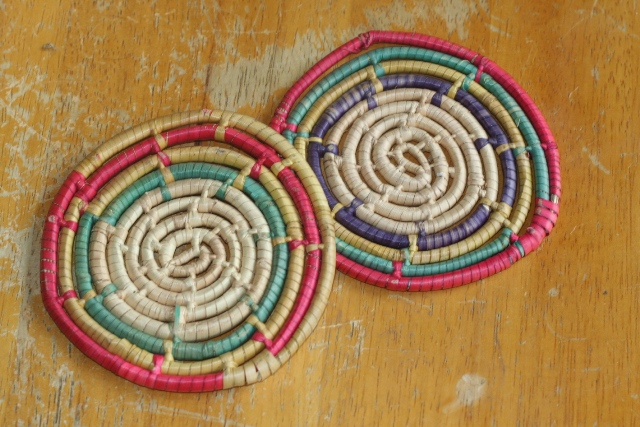
Three fascinating brass leaves, kinda a mystery as well, or two colorful woven coasters.


But wait, there’s more!
As a thanks for visiting our blog, stop by our shop through March 1 2011, and use coupon code  “mystery1” to receive %18 off any purchases.


Search Amazon for:
Ceramics

Some Guesses?


UPDATE
I feel like MythBusters.  We ran some experiments and are awarding a prize to the most plausible case.  The flower frog seemed like a forerunner, but no matter what size vase we used or how we tried to sit the thing on top, it never really balanced right.  The flowers in the holes are what kept it in place.  It clearly didn't strike us as being built for such a purpose.  Incense holder?  It was damn near impossible to get four sticks balanced in the holes without then touching each other or falling out.  Several other ideas held intrigue.  However the one that actually seems the most plausible is "The Tea Bag Holder" .  It actually fits nicely on the rim of the mug and the main area sits parallel with the floor in this configuration.   We found that with it on the inside, the bag actually sat under the water, but then you could lift the bag and with the back of a tea spoon press all the water out nicely.    

Cograts to Inge, your brass leaves are on the way!